I always thought that the question of, whether social change must precede political change in India had been suitable answered by the event of Indian Independence in 1947.This event I though was a classic case where political change preceded social change, thereby giving us Indians an opportunity to facilitate social change. Apparently this event seems to have gone unnoticed when talking about bringing about social/political change in India. The question revisited me under a peculiar context again, during the live chat organised by the Freedom Team of India to discuss the strategy of having leaders first in the team to lead India, before we actually hit the political ground, there was a lot of talk on this theme, mostly in favour of social change first. It was a chat called “Leaders First” organised by Mr Shantanu Bhagwat, a member of The Freedom Team of India whose blog can be viewed at http://Satyameva-Jayate.org. For those who may be interested in the Transcript of the chat may visit Sanjeev Sabhloks blog at http://sabhlokcity.com/2011/01/transcript-live-chat-26-january-2011-leaders-first/. There were various threads that emerged from the chat however; the one that got me curious was about precedence of social and political change. The chat was informative and thought provoking and I highly suggest those interested in doing their bit for India to go through it.
Views were aired by the participants regarding a need for social change and all the reluctance or the arguments against joining politics somewhere hit this line of thought. Previous to the chat I had not thought about this issue in a perspective of being a hindrance to joining/supporting a better alternative in politics, nor did I understand that this would manifest as a kind of a shadow lurking in the minds of the people. In some sense I thought that it signified a lack of confidence in them and by implication in our on-going project to bring about change in India. Well, here is my response to them and a case for why political change should precede social change in India? I sincerely hope that I may be able to change a few minds that India needs urgently for making it a much better India.
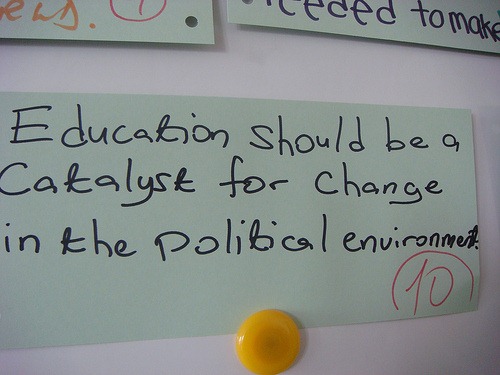
Coming back to the question I wish to explore, if we were to look at history of the world closely, the case for social change invariably preceding political change is very weak. To take a view in history of India at a close range to facilitate better understanding of the question is the Indian freedom movement. In the late 1800’s and the early 1900’s the freedom fighters of India were precisely wrought into a similar dilemma as to whether, social change should precede political change. And, a few of the fighters stuck to the first and few to the second. No conclusive view emerged then, at a time when the idea of India needed those therapeutic measures. Gopal Krishna Gokhale, a man of brilliance and erudition maintained that political change will automatically lead to social change. He argued that after having got freedom, we should be in a better position to argue out the need for the social change and how far we could actually take the proposed changes as a free people. His was perhaps the first of its kind articulation, until later Gandhi amalgamated the two into a simultaneous process.
Now let’s move a little forward to the time of independence 1947. What happened then? Of course, India got freedom. But, what else did happen? Well political change preceded social change. The whole of the country, every citizen got enfranchised; they in fact got the right to vote when most of the western countries did not give all their citizens the power of the ballot. Some countries withheld the power of the ballot from women, others from differently coloured still others for various other superficialities. But India was different with a stroke of a pen all citizen became equal not in word but indeed. This is perhaps the best example of political change preceding social change. Why? Because, the founding father believed that a country as vast and as complex as India, where social change was desperately need could come about only if we had political change first. How else could the possibility of breaking the caste hierarchy emerge, or the empowerment of woman in a hopelessly patriarchal society take roots, and how else could the consolidated geographical entities be merged into a single union with an Idea of India.

At the time of being granted independence, India was a country at the bottom of most of the social indices, very much like today (but that would be better left for another occasion). Now, the state of the nation at the time was miserable in terms of social practices as well, as can well be gauged from the fact the founders had to pass a number of legislation specifically targeting social practices, ranging from dowry, inheritance, to sati and civil rights. Untouchabilty was viewed as such a heinous crime by the founding father that they resorted to place it in the section under the fundamental rights of the constitution of India. It was a still remains one of the biggest social evils in existence in India. Some of the laws against these social evils were passed by the British in the early part of the nineteenth century. The practise of untouchabilty alone stands nullifies the guarantee of equality for all citizens under the constitution. And, still it exists. Did they wait for social reform before political reform? If they had operated upon such logic I think we would not have gotten Independence let alone an attempt at social changes through political empowerment.
Social change is in a sense political change, every social change empowers people as is the case in political change. To expect that one must be a precondition for the other to proceed is erroneous thinking. Social changes coming into effect without having political setup to facilitate that is empty, and political changes without social practices to support them is blind. They have and always work in tandem. Any attempt to separate the two or give precedence to one over the other in terms of political/social activity will lead either to exploitative practices or worse a tyranny of the political class in social guise, India is the case is point for the latter.
Here is a illustrative list of laws passed in India during the past two centuries aiming at specifically curbing social evils, thereby bring about/facilitating social change. The effectiveness of the laws and their implementation are a question, which the readers have to make an assessment for themselves. However the list is illustrative is a sense if it makes my case stronger by asking a question. Would these social evils have been curbed or attempted to be curbed without a political change that followed in India after 1947? This list is below, as follows;
1. Caste Disabilities Removal Act 1850
2. Public Gambling Act 1867
3. Indian Divorce Act 1869
4. Marriages Validation Act 1892
5. Lepers Act 1898
6. Ancient Monuments Preservation Act 1904
7. Anand Marriage Act 1909
8. Hindu Inheritance (Removal of Disabilities) Act 1928
9. Child Marriage Restraint Act 1929
10. Children (Pledging of Labour) Act 1933
11. Hindu Marriage Act 1955
12. Immoral Traffic (Prevention) Act 1956
13. Dowry Prohibition Act 1961
14. Untouchabilty (Offences) Amendment and Miscellaneous Provision Act 1976
15. Narcotic Drugs and Psychotropic Substances Act 1985
16. Muslim Women (Protection of Rights on Divorce) Act 1986
17. Indecent Representation of Women (Prohibition) Act 1986
18. Child Labour (Prohibition and Regulation) Act 1986
19. Scheduled Castes and the Scheduled Tribes (Prevention of Atrocities) Act 1989
20. National Trust for Welfare of Persons with Autism, Cerebral Palsy, Mental Retardation and Multiple Disabilities Act 1999
21. Protection of Women from Domestic Violence Act 2005
22. Commissions for Protection of Child Rights Act, 2005
23. Prohibition of Child Marriage Act 2007
24. Right of Children to Free and Compulsory Education Act, 2009

Now, to wait for social change to happen first and expect that political reform will follow swiftly is wishful thinking. It will never complete its intended project without the support of political setup. Moreover, historically political changes in a society have led to massive social changes as in the case of England, France, America and many more countries. One of the reasons as to why this should be so, is that, to bring about social unity for instance in a country as diverse as India is not only an impossible task but a path to folly. Where as to bring about a political unity in this country would be not as difficult, a unity of one nation, one people which has be elusive so far. Elusive not because people can’t be united, elusive because the uniting factor has been social rather than political, regional rather than national in character. This path to folly will only lead to a disaster in form of the quagmire that we are in today. This can only be arrested by having political change first as a result of political unity. One nation, one people!
To all the cynics who will tell us that is impossible, that because it has never been done before, that we are too young to undertake this giant leap of faith, faith in the rule of law, faith in freedom for everyone, faith in the unity of a nation as one people. We the people must not allow those who practise the politics of division, of hate, of fear to sacrifice our future to the altar of the past. People, who vehemently will oppose political change to the precedence of social change, are the very same people who are scared to lose this status quo, they are the centres of powers that will refuse to budge, but we must train ourselves, and train ourselves well to see through this guise. They are the opposition to the future we seek.
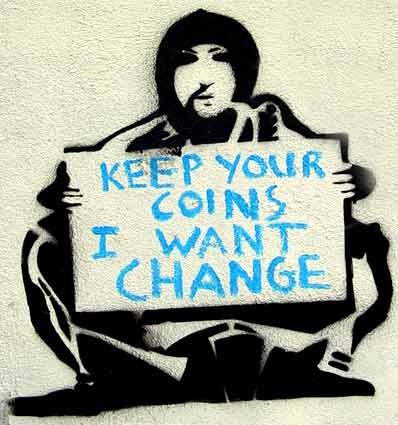
Give people political freedom and they will create a heaven, restrict them socially and they will perish in the hell of their making. It is time we stopped making excuses of what should come first and what next and concentrate our energies to create a conducive political environment to facilitate the social change. When we bring about political change, is it any different than bring about social change? The time has come for us to start to sense the spectre that is haunting India, the spectre of freedom, prosperity and dignity. It is for us to take the mantle of a more prosperous, free India. It is our duty as citizens of a free nation to pass the baton to the future generations in a much better health, a stronger unified Union of India.


 Vidyut Jain's Blog
Leave a reply to Sanjeev Sabhlok Cancel reply